
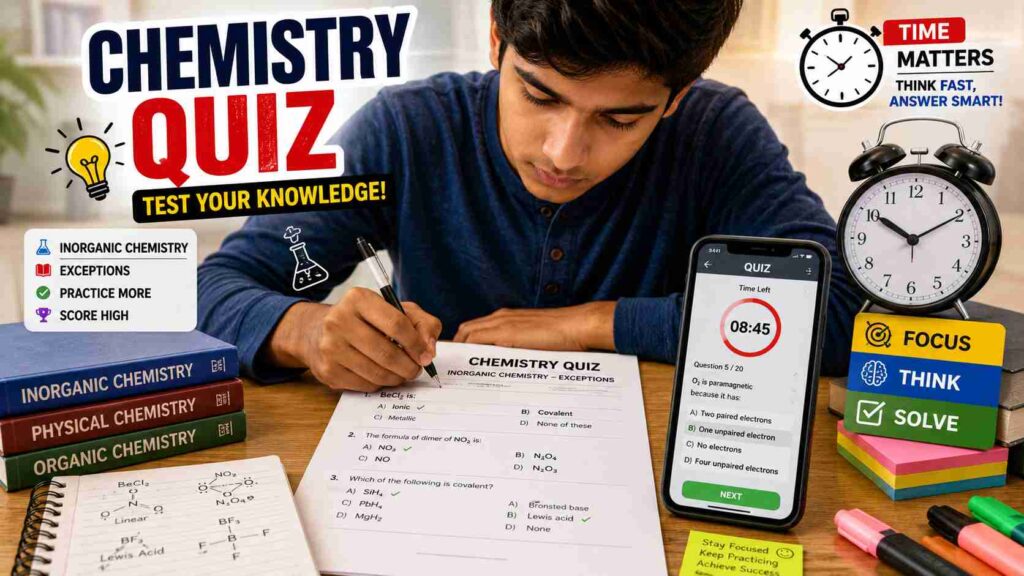
Inorganic Chemistry is a subject where the usual rules are left aside and exceptions are aplenty while preparing for the JEE Main exam. If you want to get a grip on these exceptions and increase your score, the easiest and most effective way is to create your own quizzes and practice them daily.
If you create a quiz on inorganic chemistry exceptions to help me revise for my jee main exam. Using this method, revision becomes extremely easy in the last days and the confusion in the exam is completely eliminated.
Inorganic chemistry, the most common exceptions are in the areas of block elements, chemical bonding, and coordination compounds. To remember these exceptions, practicing through quizzes is considered the best solution rather than memorizing. When you create your own questions and find the answers, the brain remembers the information for a longer time.
Why are exceptions in inorganic chemistry a headache and how to overcome them?
Hey friends, when you open an inorganic chemistry book while studying for the JEE exam, everything seems easy at first. But as you go further, you start seeing more exceptions than rules. Be it electron affinity or ionization enthalpy, you see something different happening on every page.
Our brain quickly accepts general rules, but when something goes against the rules, we get confused under the pressure of exams. For example, we don’t remember the size trends and electronic configuration exceptions in the boron family or d block elements in a timely manner.
The only solution to this is to create a quiz on inorganic chemistry exceptions to help me revise for my jee main exam. Use this formula in your daily study. When you spend 10 to 15 minutes every day solving questions based on these exceptions, it will remain in your memory forever.
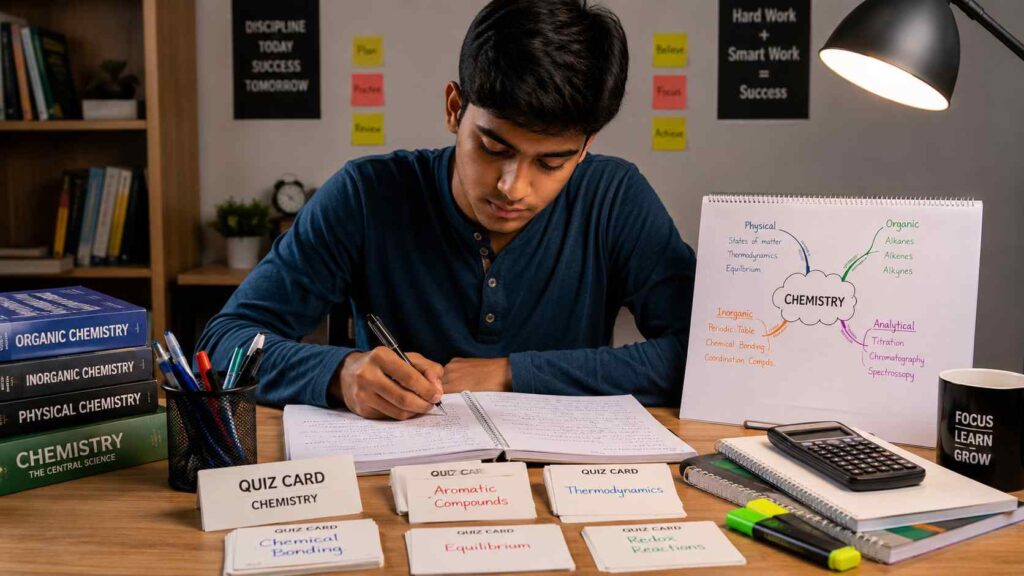
The easiest and most effective way to create a quiz
Creating a quiz is not a huge task. You can create your own questions in a very simple way. First of all, keep your notes or NCERT book in front of you. Wherever you see exceptions, write them down in a separate notebook.
While creating questions, they should be either four-choice or direct one-word answers. For example, which element in the p block has an unexpected electron gain enthalpy? or which elements in the d block show an unexpected electronic configuration? If you use this method at the end of your study, you will revise at a different pace.
Which elements should be included in the quiz?
- Exceptions to dipole moment and bond angle in chemical bonding
- Trends in acidic strength and hydrides in p block elements
- Oxidation states and magnetic properties in d and f blocks
- Spectrochemical series and isomerism in coordination compounds
Important Exceptions and their Revision Table
| Concept / Factor | General Rule | Actual Exception | Main Reason |
| Electron Affinity | Decreases moving down a group | Chlorine has a higher electron affinity than Fluorine | Small size of Fluorine and electron-electron repulsion |
| Ionization Enthalpy | Increases from left to right across a period | Beryllium has a higher ionization enthalpy than Boron | Completely filled ‘s’ orbital of Beryllium |
| Electronic Configuration | Electrons fill according to the Aufbau principle | Unexpected electronic configuration of Chromium and Copper | Stability of half-filled and fully-filled orbitals |
| Bond Angle | Decreases as the size of the central atom increases | The bond angle of water (H2O) is much greater than hydrogen sulfide (H2S) | Drago’s rule and lack of hybridization |
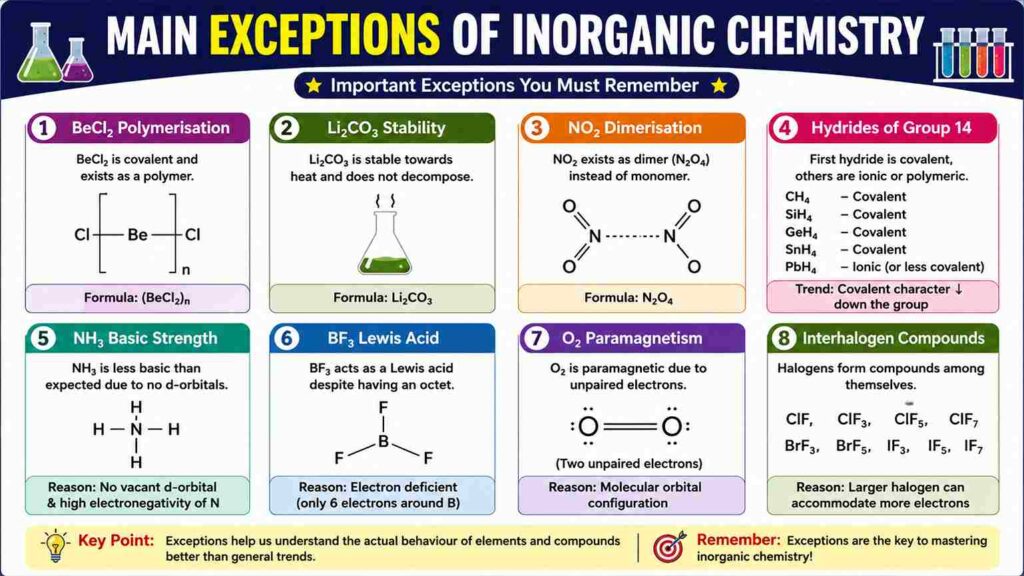
See the table below, which lists some of the major exceptions that are very important for the JEE Main exam and their reasons in simple language.
Double your revision speed with smart tricks
It is difficult to remember exceptions just by reading books. For this, create some fun shortcuts and mnemonics. Code words made in your own language are easy to remember on exam day.
When you create a quiz on inorganic chemistry exceptions to help me revise for my jee main exam. work on this concept, make sure to write a short explanation of why it happened along with the questions below the answers. This will not only make the answer clear, but also make the concept behind it clear. Even if the question is asked in a roundabout way in the exam, it will be easier to answer.
How to plan your time in the last days of the exam?
Don’t waste time reading new books when there are only a few days left for the exam. During this time, only two things should be emphasized: practice and revision. Every morning after waking up or before going to bed at night, set aside 15 to 20 minutes just for this chemistry quiz.
If you are studying with friends, ask each other these questions. When you ask or answer a question to someone, the topic becomes permanently fixed in your mind. This practice method increases confidence and helps reduce negative marks in the exam.
Common mistakes and how to avoid them?
Often what students do is that they memorize the general rules and ignore the exceptions. Or they try to memorize all the exceptions in one day. This is a big mistake. Exceptions have to be studied gradually and a little bit every day.
Another mistake is just memorizing the answers without reading the explanations. In JEE Main, the number of direct questions has decreased now, more concept-based questions are asked. Therefore, it is very important to understand the logic behind each exception.
If you regularly create a quiz on inorganic chemistry exceptions to help me revise for my jee main exam. If you keep practicing this technique, it will be very easy to avoid these mistakes.
Disclaimer
This article is written only for the convenience of students and as a guide for preparing for the JEE Main exam. All the information, rules and exceptions given in the article are based on honest study experience and available educational materials. The National Testing Agency may make changes in the syllabus or format of the exam from time to time.
Therefore, students should always check the information on the official website and the original NCERT books. Using the tips in this article will help in improving their studies, but the full responsibility for the final result will depend on the student’s own hard work and preparation.
What is the Main Focus of Play Mode in Scout? Explained Simply
1.Are NCERT books sufficient for all the exceptions of Inorganic Chemistry?
Yes, NCERT books are the most important and reliable source for JEE Main exam. If you study every line and table in them properly, most of the questions can be solved easily.
2.What is the easiest way to remember exceptions?
Using flash cards daily, creating short quizzes yourself and practicing by making mnemonics is the easiest and most effective way to remember exceptions.
3.How to avoid negative marks in questions in this subject?
If you do not know the exact reason for an exception or are not completely sure, then avoid giving approximate answers. Build your confidence by solving as many quizzes as possible in practice tests.
4.How much time should be given to this part of Chemistry every day?
Dedicating 15 to 20 minutes of daily study just for exceptions and their revision is enough. If you maintain regularity, there is no extra stress during the exam.